PrimerRG — gnomAD AF-Aware Genomic Primer QC
Resonance Genomics provides gnomAD primer QC through research-use-only computational screening of existing genomic PCR primers. PrimerRG uses AF-aware population-variant overlap assessment to identify primer-binding regions that may warrant additional laboratory review.
The workflow incorporates genomic positioning, reference-assembly verification, and joint allele-frequency measures (AF_joint and AF_grpmax_joint) to assess population variation across primer-binding regions. Particular attention is given to variants near primer 3′ termini, where sequence mismatches may be relevant to amplification performance.
Computational screening does not establish allelic dropout, amplification efficiency, or clinical assay performance. Findings are intended to support laboratory review and require independent experimental assessment where appropriate.
Published Scientific Evidence
Our PrimerRG technical research report, Allele Frequency-Aware Genomic Primer Design and Quality Control Using gnomAD (2026), documents population-variant overlap assessment using gnomAD and joint allele-frequency measures (AF_joint and AF_grpmax_joint). The study also evaluates computational primer redesign strategies, while the current Resonance Genomics service focuses exclusively on QC screening of existing primers.
Workflow Features
- Batch QC screening of existing genomic PCR primers against gnomAD population-variant data
- AF-aware assessment of variants overlapping primer-binding regions using AF_joint and AF_grpmax_joint
- Identification of variants overlapping primer 3′ terminal positions, including the terminal five nucleotides
- Reference-assembly and genomic-coordinate verification for primer-binding regions
- Structured reporting of variant overlaps, allele-frequency evidence, and potential binding-site vulnerabilities
- Laboratory-oriented QC outputs to support independent review and assay evaluation
- Research-use-only computational assessment without primer design, redesign, or experimental performance claims
Why gnomAD Primer QC Matters
Population variants within genomic PCR primer-binding regions may introduce sequence mismatches between a primer and its intended target. Depending on their location and the assay conditions, these mismatches can affect primer binding or amplification, particularly when they occur near the primer’s 3′ terminus.
Conventional primer evaluation does not always incorporate population allele-frequency evidence across all binding positions. AF-aware screening using gnomAD can help laboratories identify existing primers with potentially relevant variant overlaps and prioritize them for further review.
PrimerRG provides computational evidence to support this assessment. Identifying a population-variant overlap does not, by itself, establish allelic dropout, amplification failure, or reduced analytical sensitivity.
Structured Review Outputs
- Primer-level QC summary: Structured results for each submitted primer, including genomic mapping and review status.
- Population-variant overlaps: Identified gnomAD variants intersecting primer-binding regions, with relevant allele-frequency information.
- AF-aware assessment: Joint allele-frequency measures (AF_joint and AF_grpmax_joint) to support evaluation of population-variant overlap.
- 3′ terminal risk indicators: Identification of variants overlapping the terminal five nucleotides and other relevant primer-binding positions.
- Laboratory-ready reports: Structured Excel-compatible outputs to support filtering, documentation, and independent laboratory review.
- Outputs identify potential primer-binding vulnerabilities; they do not establish experimental amplification performance or replace laboratory validation.
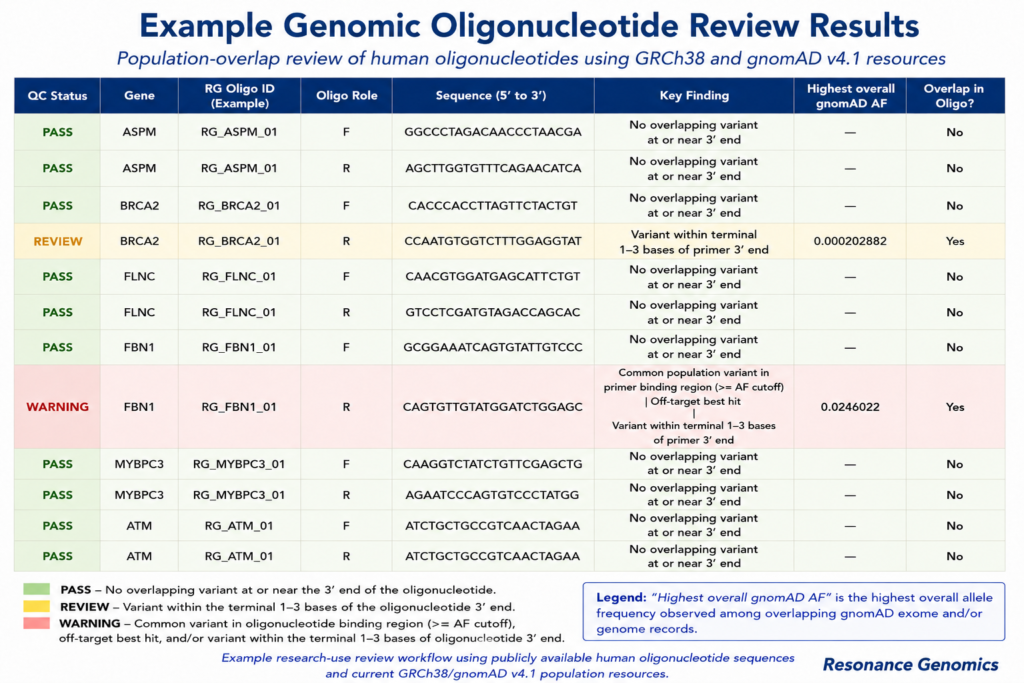
Example structured laboratory review output illustrating population-variant overlap assessment, 3′ terminal risk review, and primer-level QC flagging using GRCh38/gnomAD-aligned resources.
Research Use Statement
These workflows are intended for research-use and internal laboratory review support only. Outputs are not designed for diagnostic reporting or independent clinical decision-making.
Resonance Genomics provides research-use support for laboratories performing large-scale genomic oligonucleotide review, population-variant overlap analysis, sequence-context assessment, and assay-risk evaluation. Final validation and implementation decisions remain under laboratory control.
Discuss Workflow
Resonance Genomics offers project-based, research-use-only gnomAD AF-aware QC screening of existing genomic PCR primers. Laboratories can contact us to discuss primer collection size, reference assembly, review objectives, expected deliverables, and turnaround time. Appropriate secure file-transfer arrangements will be established before any confidential sequence files are submitted.