Structured Genomic Evidence Infrastructure
Structured aggregation of variant-level evidence for laboratory review and quality control.
Resonance Genomics provides research-use-only computational services for rare disease variant prioritization, including HPO-driven whole-exome sequencing (WES) and whole-genome sequencing (WGS) analysis. Our phenotype-driven approach integrates structured genomic evidence, inheritance-aware ranking, and AF-aware variant assessment to support laboratory review of candidate genes and variants, including previously unresolved rare-disease cases.
Explore our HPO-driven WES/WGS variant prioritization service — Learn about phenotype-based ranking, inheritance-aware genomic analysis, research applications, and the published controlled evaluation.
Published Scientific Evidence
Rare-Disease Variant Prioritization: Our HPO-driven rare-disease variant prioritization technical white paper describes the computational framework, phenotype-aware ranking methodology, and controlled research evaluation, including its limitations.
PrimerRG — AF-Aware Primer QC: Our genomic primer QC research report documents the assessment of population-variant overlap with genomic primer-binding regions using gnomAD and joint allele-frequency measures (AF_joint and AF_grpmax_joint). The published study also evaluates computational redesign strategies; the commercial PrimerRG service focuses on screening existing primers rather than designing or redesigning them.
Scientific Background
Workflows are developed and overseen by a clinical genomics scientist (Mahdi Ghani, MD, PhD) with over a decade of experience in diagnostic genomics, assay development, and variant interpretation. Scientific contributions include more than 50 peer-reviewed publications and over 2,400 citations spanning rare disease genomics, assay validation, sequencing workflows, population genetics, and variant interpretation.
All infrastructure is designed for research-use evaluation within established laboratory workflows.
Project-based research-use support is available for laboratories that need structured genomic review outputs without developing and maintaining specialized internal infrastructure.
Laboratory Workflow Support Areas
Laboratory workflow support services available for clinical genomics laboratories, molecular diagnostics programs, assay development groups, and research organizations. Structured review outputs are delivered as laboratory-ready workbooks and reports designed to support QC, validation, assay review, and genomic evidence assessment workflows.
Available Services
• Project-based laboratory review support
• Large-scale oligonucleotide QC review
• Capture design and coverage review
• ClinVar-driven intronic locus assessment
• HPO-aware WES/WGS reanalysis support
• Variant evidence organization and submission support
Rare Disease Variant Prioritization
Phenotype-driven WES/WGS review workflows integrating HPO semantic similarity, ClinVar/literature evidence, transcript context, splice prediction, population frequency resources, and structured variant-prioritization and review scoring.
Risk Alleles Extraction
Structured extraction of low-penetrance, susceptibility, and risk-associated variants from public genomic resources and curated evidence datasets.
Variant Submission Workflows
Standardized preparation and organization of variant evidence for public database submission workflows and structured review support.
PrimerRG — GnomAD Aware Primer QC
Research-use-only genomic primer screening for population variants, with AF-aware assessment of binding sites and 3′-end vulnerability. Structured QC reports support laboratory review and primer redesign.
Capture Design Review
Review of panel coverage completeness, exon representation, splice-adjacent regions, and transcript-aware target inclusion. Identification of potentially underrepresented clinically relevant regions.
Intronic Variant Mapping
Identification of clinically relevant intronic loci from current ClinVar releases mapped relative to transcript structures and target regions. Organization of supporting evidence and structured variant-review documentation.
Featured Workflows
Selected workflow areas currently emphasized within RG infrastructure include phenotype-driven WES/WGS prioritization and large-scale genomic oligonucleotide QC workflows supporting primers, probes, and related assay components.
HPO-Driven WES/WGS Variant Prioritization
Phenotype-driven WES/WGS review workflows integrating HPO semantic similarity, inheritance-aware prioritization, transcript context, splice prediction, ClinVar/literature evidence, and population-frequency resources.
RG infrastructure includes structured transcript-aware review scoring designed to support laboratory-oriented prioritization workflows across GRCh37 and GRCh38 review contexts, while allowing existing internal interpretation and approval workflows to remain in place.
- • HPO semantic similarity and information-content (IC) scoring
- • Inheritance-aware prioritization including AD, AR, X-linked, and de novo contexts
- • Transcript-aware review scoring and structured evidence integration
- • Integration of ClinVar, splice prediction, conservation, and population-frequency resources
- • Structured laboratory-oriented review outputs for internal workflow support
Rapid Large-Scale Genomic Oligonucleotide Review
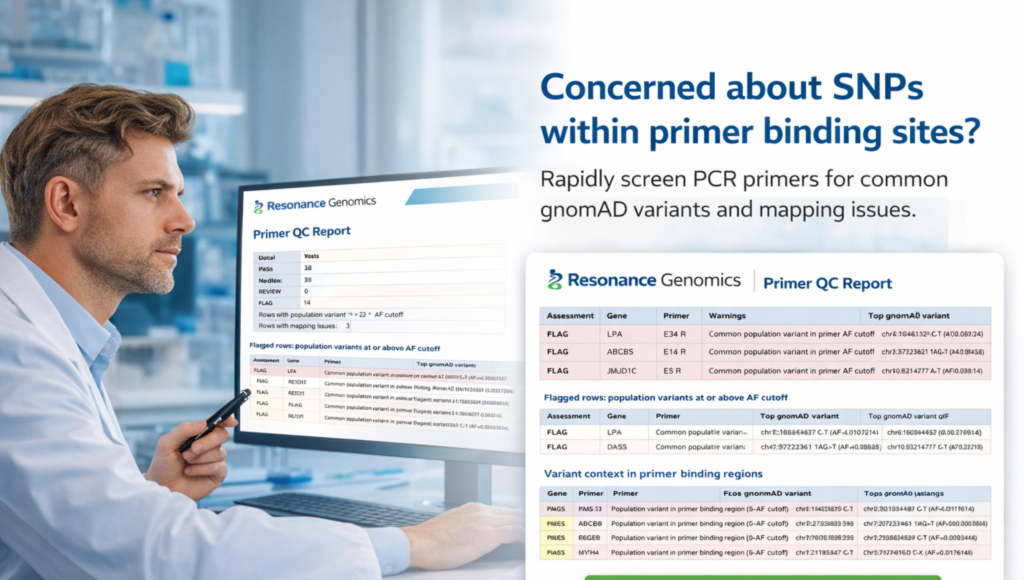
Resonance Genomics provides research-use workflows for rapid large-scale review of genomic oligonucleotides using current GRCh38 and gnomAD population resources.
The objective is not to replace laboratory validation, but to provide a scalable pre-screening layer that helps prioritize manual review efforts across large oligonucleotide collections.
Workflows evaluate:
- Population variant overlap using current gnomAD resources
- Variant position relative to oligonucleotide sequence context
- Terminal-position risk assessment (including 3′ end review where applicable)
- Transcript-aware genomic context
- Mapping and sequence-specificity review
- Assay-review prioritization support
Applicable oligonucleotide types include PCR primers, MLPA probes, qPCR assays, hybridization probes, targeted sequencing assays, and other genomic assay oligonucleotides.
Why Resonance Genomics
- Structured genomic evidence workflows designed for internal laboratory review
- Transcript-aware infrastructure using current MANE frameworks
- Support for GRCh37 and GRCh38 review contexts
- Public-resource-driven reproducible workflow organization
- Research-use outputs designed to complement existing laboratory workflows
Confidential Research Collaborations
• Assay sequences, probe content, and workflow details are treated as confidential research materials.
• Collaborative reviews are designed as research-use support workflows for internal laboratory evaluation.
• RG does not publicly disclose shared assay content, benchmarking examples, or organizational workflows without explicit permission.
• Support may include transcript-aware coordinate review, population-resource overlap assessment, mapping-specificity context, and sequence-context evaluation across evolving genomic references.
Research Use Statement
Resonance Genomics workflows are intended for research-use support and internal laboratory review only. Outputs are not designed for diagnostic reporting, independent clinical decision-making, or final clinical interpretation.
DATA SOURCES & ATTRIBUTION
Resonance Genomics infrastructure operates exclusively on publicly available and licensed data sources, including but not limited to:
- ClinVar public releases (NCBI)
- GWAS Catalog (European Bioinformatics Institute)
- gnomAD population frequency datasets
- PubMed-indexed literature
- Public computational annotation resources
All structured outputs maintain clear source attribution and release-version transparency.
GUIDELINE & THRESHOLD REFERENCE
Resonance Genomics does not apply guideline thresholds, assign evidence strengths, or perform interpretation. Laboratories should consult original guideline publications to determine relevant threshold values.
For reference:
https://cspec.genome.network/
SCOPE & OPERATIONAL BOUNDARIES
Resonance Genomics provides evidence aggregation and documentation support only.
- No clinical variant classification
- No diagnostic interpretation
- No assignment of pathogenicity
- No patient-identifiable data ingestion or storage
All services support internal laboratory research and review workflows.
PLATFORM PRINCIPLES
- Public-data-only processing and attribution
- Transcript-consistent evidence structuring
- Reproducibility and transparency in outputs
- No patient-identifiable data ingest or storage
- No clinical classification or interpretation provided
- Source-version documentation for updates
CONTROLLED INFRASTRUCTURE ACCESS
Services are available to research laboratories and clinical genomics groups upon request and institutional review.
Laboratory Evaluation
Resonance Genomics workflows are available for evaluation by research and clinical genomics laboratories interested in structured variant evidence aggregation and workflow optimization.
If your laboratory is interested in evaluating these tools or discussing potential collaboration, please contact us.