HPO-Driven WES/WGS Variant Prioritization
Phenotype-driven genomic evidence prioritization for structured laboratory review workflows.
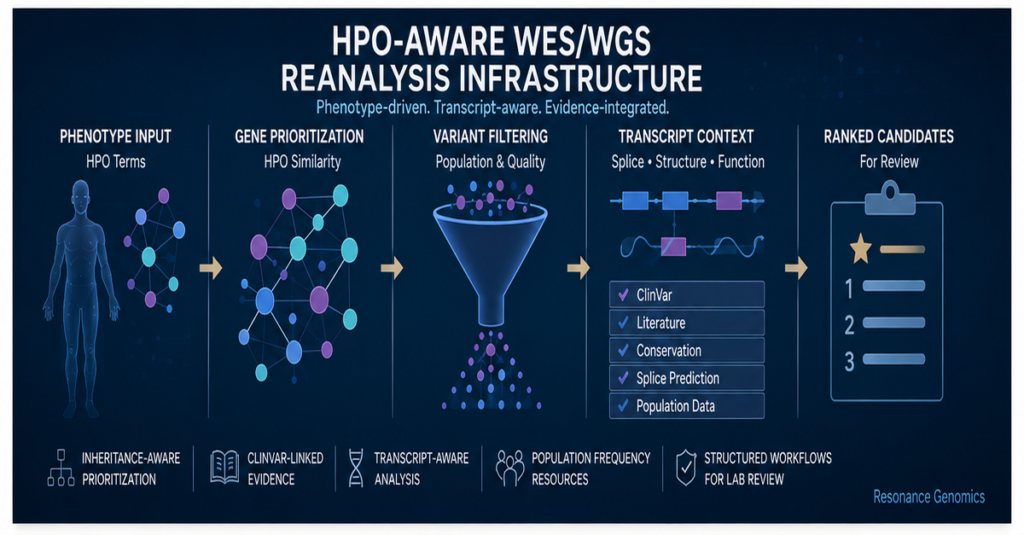
Resonance Genomics provides research-use-only rare disease variant prioritization for whole-exome sequencing (WES) and whole-genome sequencing (WGS) datasets. Our phenotype-driven workflow integrates Human Phenotype Ontology (HPO) semantic similarity, inheritance-aware variant ranking, and structured genomic evidence to help laboratories review candidate genes and variants. The service is intended to support research evaluation of rare-disease cases, including previously unresolved WES/WGS analyses, while preserving independent laboratory interpretation and review.
The infrastructure integrates HPO semantic similarity, inheritance-aware review context, transcript-aware annotation, splice prediction resources, population-frequency data, and structured literature evidence into concise laboratory-oriented review outputs.
Designed to support internal laboratory review of unresolved or previously negative WES/WGS cases.
Published methodology and controlled evaluation: Read our HPO-driven rare-disease variant prioritization technical white paper (2026).
Core Infrastructure Features
- HPO semantic similarity and information-content (IC) scoring
- Inheritance-aware prioritization including AD, AR, X-linked, and de novo contexts
- Structured integration of ClinVar, transcript-aware annotation, splice prediction, conservation context, and population-frequency resources
- Structured organization of variant-linked publication and citation evidence
- GRCh37 and GRCh38 workflow support
- Concise review-oriented outputs designed to complement existing laboratory workflows
- Research-use-only (RUO) support for internal laboratory review processes
Rare Disease Variant Prioritization for Laboratory Review
Rare disease variant prioritization requires more than identifying uncommon variants or predicting their molecular consequences. Candidate genes and variants must also be considered in the context of the observed phenotype, inheritance pattern, genotype, population allele frequency, and available disease-associated evidence.
Resonance Genomics integrates structured HPO-based phenotype similarity with inheritance-aware ranking and AF-aware genomic evidence to organize candidate findings for laboratory review. This approach is intended to support investigation of unresolved WES/WGS datasets and help scientific teams focus their evaluation on candidates supported by multiple complementary lines of evidence.
The resulting prioritization is a research-oriented ranking, not a determination of pathogenicity. Candidate variants require independent laboratory assessment, and any clinical interpretation remains the responsibility of appropriately qualified professionals.
Scientific Methodology and Validation
The scientific methodology and research validation of Resonance Genomics’ HPO-driven WES/WGS variant-prioritization approach are described in our published technical white paper. The report documents the computational framework, structured phenotype-based ranking, and evaluation within a controlled research cohort, including the study’s limitations.
Read the RG Variant Prioritization Technical White Paper
The publication provides supporting research evidence and does not establish clinical diagnostic performance or replace independent laboratory validation.
Research Use Statement
These workflows are intended for research-use and internal laboratory review support only. Outputs are not designed for diagnostic reporting, independent clinical decision-making, or final clinical interpretation.
Discuss Workflow
Resonance Genomics provides project-based, research-use-only HPO-driven WES/WGS variant prioritization to support laboratory review of candidate genes and variants, including previously unresolved cases. Laboratories can contact us to discuss phenotype information, sequencing data requirements, project scope, expected deliverables, and turnaround time. Appropriate secure file-transfer arrangements will be established before any confidential genomic or patient-related information is submitted.